


Principle 1
What the Science Tells Us About Substance Use Disorders
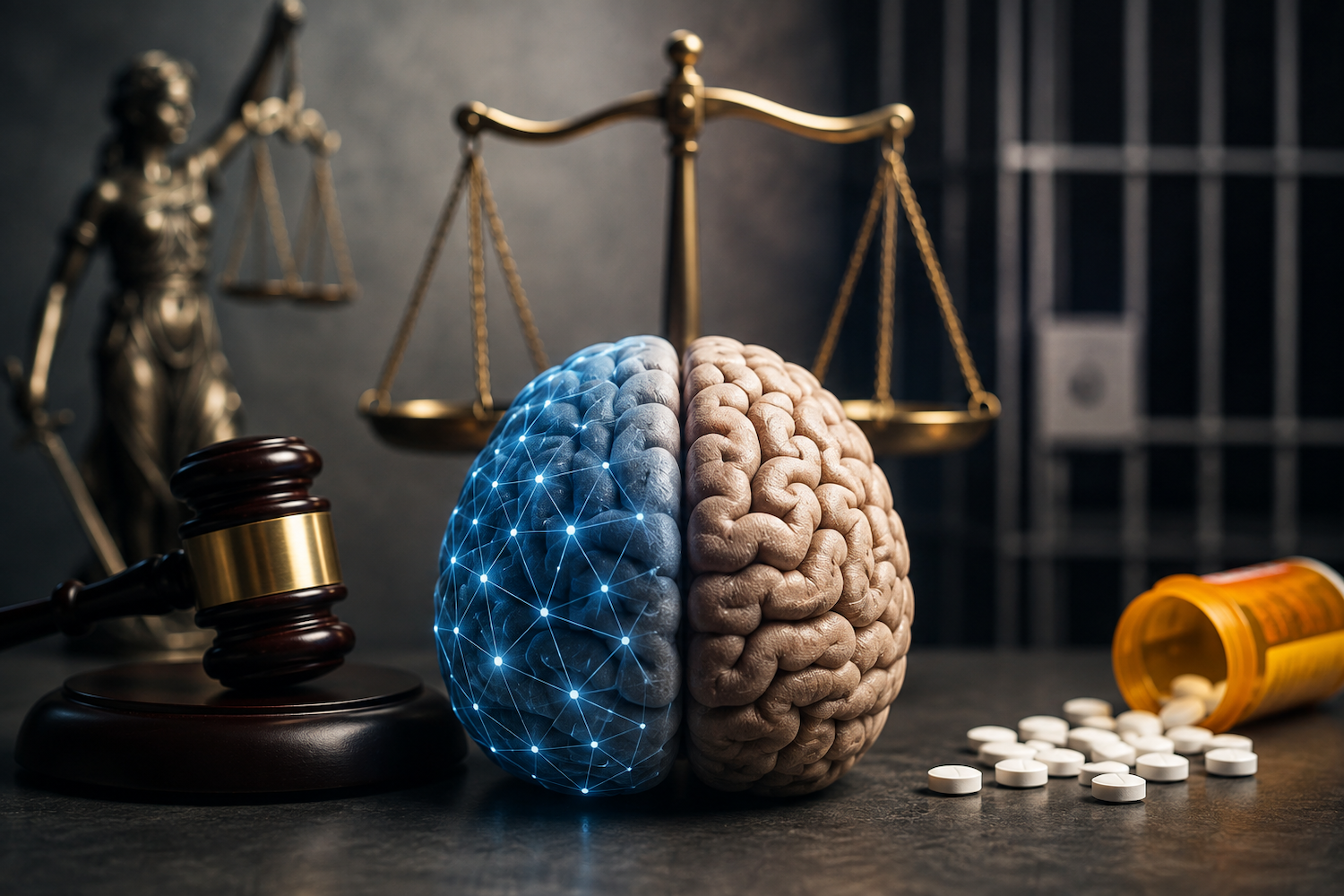
Substance use disorders historically have been primarily viewed as moral failings or problems of willpower.[1] Individuals who repeatedly used alcohol or drugs despite harmful consequences were often seen as making poor choices that deserved punishment rather than treatment.[2] These beliefs shaped public policy, influenced criminal justice practices, and affected how courts responded to people with substance use disorders.[3]
Over the past several decades, scientific research has fundamentally changed our understanding of addiction.[4] This research has shown that while personal choices influence whether someone first uses alcohol or drugs, repeated substance use produces measurable changes in brain circuits involved in reward, motivation, memory, learning, stress response, and self-control.[5] This evidence-based understanding helps to explain why individuals suffering from Substance use disorders (SUDs) may continue using despite serious consequences, including deteriorating health, damaged relationships, loss of employment, and repeated involvement with the justice system.[6] SUDs are now recognized as chronic, treatable medical conditions that affect brain function and behavior.[7]
This evidence-based understanding has important implications for how the justice system responds to individuals with SUD. Recognizing SUD as a chronic medical condition does not eliminate the importance of personal responsibility. Instead, it provides a better understanding of the conduct justice professionals encounter and helps explain why simply directing someone to stop using substances may not be enough.

Understanding the Chronic Nature of SUD
An important part of understanding SUD is recognizing its chronic nature.[8] Like other chronic health conditions, symptoms can improve, worsen, or recur over time.[9] An individual may experience a period of stability followed by renewed substance use, just as symptoms of other chronic conditions may return and require a change in care.[10]
This helps explain why recovery is often a process rather than a single event.[11] A return to substance use does not necessarily mean that an individual is incapable of recovery or that every aspect of treatment has failed. It may indicate that the person’s clinical needs have changed and should be reassessed.[12]
For the justice system, this distinction matters. A response based solely on the immediate behavior may miss important information about what is driving that behavior and what response is most likely to reduce it in the future.
Understanding What Treatment Can Accomplish
Recognizing SUD as a chronic medical condition also changes what we should expect from treatment. Effective treatment exists, but it must be matched to the individual and may need to change over time.[13] Treatment can include behavioral therapies, counseling, medications when clinically appropriate, recovery supports, or combinations of these approaches.[14]
The important point for justice professionals is that substance use disorder is not an untreatable condition. People can and do recover. Treatment can reduce substance use and its harmful consequences and can help individuals improve their health, relationships, stability, and functioning. What effective treatment looks like, and what recovery means in practice, are the focus of the next principle: Treatable.

Why Understanding Matters in the Justice System
Justice professionals do not need to become addiction medicine specialists or treatment providers. But they make decisions every day involving people with substance use disorders. Judges determine conditions and responses to behavior. Prosecutors and defense attorneys make decisions that affect access to treatment. Probation and parole officers respond to conduct during supervision. Correctional officials make decisions about care during incarceration and reentry.
A basic understanding of SUD helps these professionals recognize when behavior may have a clinical component, when clinical expertise is needed, and when a response should address both accountability and treatment needs. It also helps avoid unrealistic expectations about how quickly behavior will change.
Understanding Changes the Response
How the justice system understands a problem inevitably influences how it responds to that problem. If repeated substance use is viewed only as defiance, unwillingness to change, or failure to follow directions, the natural response may be increasingly punitive. But when justice professionals understand impaired control, craving, withdrawal, recurrence of use, and the chronic nature of SUD, a broader and more effective range of responses becomes possible.
That does not mean ignoring misconduct or excusing criminal behavior. Accountability remains an essential responsibility of the justice system. Understanding SUD allows accountability to be applied with greater precision by distinguishing the need for a justice response from the need for a clinical response and recognizing that, in many cases, both may be necessary.
Understanding also improves communication with treatment providers. Courts and supervision agencies are better positioned to ask the right questions, rely on appropriate clinical expertise, and evaluate progress without attempting to make medical decisions themselves.
Building the Framework
The first part of this series begins with Understanding because an effective response to substance use disorders must begin with an accurate understanding of the problem. Science provides that foundation. It tells us that substance use disorders affect the brain and behavior, are chronic medical conditions, and can influence judgment, decision-making, and the ability to control substance use.
Justice professionals do not need to become clinicians. They do, however, need to understand what substance use disorders are – and what they are not – so that decisions about accountability, treatment, supervision, and public safety are grounded in reality rather than assumption.
Once we understand the nature of substance use disorders, the next question naturally follows: Can they be successfully treated? Decades of research tell us that they can. That is the second principle: Treatable.
JSI’s Six Principles for Responding to Substance Use Disorders in the Justice System
1. Understanding — Start with the science.
Understanding what SUD is, how it affects behavior, and its chronic nature provides the foundation for an effective justice-system response.
2. Treatable — Recovery is possible.
SUDs are treatable conditions. Effective treatment is individualized, may change over time, and can help people achieve and sustain recovery.
3. Accountability — Recovery and public safety can coexist.
Accountability remains essential, but consequences and other justice responses should be designed to encourage behavior change, support recovery, and protect public safety.
4. Evidence — Use what works.
Justice-system decisions and practices should be guided by research, proven practices, and evidence about what produces better outcomes.
5. Stigma — Language and attitudes matter.
Stigma can influence decisions, create barriers to treatment, and undermine recovery. Reducing stigma supports fairness, engagement, and better outcomes.
6. Support — Recovery requires continuity and connection.
Long-term recovery depends on coordinated support across treatment, supervision, reentry, families, and communities.
[1] David T. Courtwright, A Century of American Narcotic Policy, in 2 Treating Drug Problems: Commissioned Papers on Historical, Institutional, and Economic Contexts of Drug Treatment 1 (Dean R. Gerstein & Henrick J. Harwood eds., 1992).
[2] Id.
[3] Id.
[4] Hannah Friedman, Beyond Willpower: The Disease Model of Addiction, Recovery.com (Dec. 6, 2024).
[5] Drugs, Brains, and Behavior: The Science of Addiction, Nat’l Inst. on Drug Abuse, (last visited Aug. 9, 2026).
[6] Id.
[7] Treatment and Recovery, Nat’l Inst. on Drug Abuse, (last visited Aug. 9, 2026).
[8] Id.
[9] Id.
[10] What Is Substance Use Disorder?, Substance Abuse & Mental Health Servs. Admin, (last visited Aug. 10, 2026).
[11] Id.
[12] Id.
[13] Id.
[14] Nat’l Inst. on Drug Abuse, Principles of Drug Addiction Treatment: A Research-Based Guide 11–12 (3d ed. 2018).
Get more articles like this
in your inbox
Subscribe to our mailing list and get the latest information and updates to your email inbox.
Thank you for subscribing.
Something went wrong.