

Justice Speaks Podcast #98
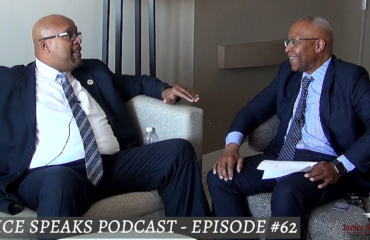
In this episode, Justice Speaks turns its focus to judicial leadership, problem-solving courts, technology, and the future of justice in Nebraska. The podcast features Chief Justice Jeffrey J. Funke of the Nebraska Supreme Court, who reflects on his path from small-town lawyer to Chief Justice and discusses the responsibilities of leading the state’s judicial branch during a period of budgetary pressure and technological change. This episode is sponsored by Reconnect.
From Nebraska City to the Bench

Chief Justice Funke grew up in Nebraska City, a small community along the Missouri River. As a first-generation lawyer, he was inspired by a neighbor who served first as a prosecutor and later as a judge. That relationship introduced him to the legal profession and showed him how a lawyer and judge could serve a community.
After law school, Chief Justice Funke returned to Nebraska City and began working as a deputy public defender while maintaining a private practice. The position placed him in the courtroom immediately and helped him develop litigation skills, learn the rules of evidence, and better understand the constitutional role of defense counsel. He later joined the county attorney’s office, serving first as a deputy county attorney and ultimately as the elected Otoe County Attorney. In that role, he handled criminal prosecutions, represented the county in civil matters, participated in death investigations as county coroner, and assisted law enforcement with warrants and other time-sensitive matters.

Nebraska’s Judicial Selection Process
Chief Justice Funke explained Nebraska’s judicial selection process, which follows the Missouri Plan. Judicial candidates are evaluated through a public process by a nominating commission, which forwards qualified applicants to the governor. Judges later face retention elections rather than contested races. His own judicial career included service on the county court and district court before his appointment to the Nebraska Supreme Court in 2016. He became Chief Justice in 2024.
As Chief Justice, he carries the same appellate caseload as the other members of the Supreme Court while also serving as the executive head of Nebraska’s judicial branch. That administrative responsibility includes overseeing court operations, working with the other branches of government, and determining how limited resources should be used. He identified budgetary constraints as one of the most immediate challenges facing Nebraska’s courts.
Chief Justice Funke emphasized that judicial leadership requires communication with legislators and the governor. Courts must explain how public funds are used, collect reliable data, and demonstrate the results produced by judicial programs. That responsibility is especially important in Nebraska because probation and problem-solving courts operate within the judicial branch. Although these programs require funding, he noted that they can reduce incarceration and other long-term justice-system costs.
The Impact of Nebraska’s Problem-Solving Courts
The conversation examined Nebraska’s expanding network of problem-solving courts, including drug, mental health, DUI, reentry, and young adult courts. Chief Justice Funke credited their success to the commitment of judges and multidisciplinary teams that include prosecutors, defense counsel, probation officers, treatment providers, and law enforcement. Together, they develop individualized plans, monitor progress, address setbacks, and recognize positive change.
He described problem-solving courts as some of the most demanding work undertaken by Nebraska judges, many of whom volunteer for the assignment in addition to their regular caseloads. Yet the results can be profound: families reunite, employment stabilizes, communities become safer, and participants are less likely to return to court. He noted that serving an individual in a problem-solving court costs approximately $5,000 per year, compared with roughly $50,000 for a year of incarceration. Those figures help demonstrate why investing in effective intervention can produce substantial long-term savings.

Technology and Artificial Intelligence in Nebraska’s Courts
Technology was another major focus of the discussion. Nebraska is working to replace a case-management system built in 1994, an undertaking expected to cost tens of millions of dollars. Chief Justice Funke explained that a modern system could improve service to court users, provide better data, and make court operations more efficient. Artificial intelligence may also assist with interpreter services, court records, and the routing and management of electronically filed documents.
At the same time, AI creates new concerns for judges and lawyers. Courts must address inaccurate AI-generated legal filings, manipulated recordings, deepfakes, and other questions surrounding the authenticity of evidence. Chief Justice Funke described the present moment as both exciting and concerning, emphasizing that courts still need better resources for identifying altered or fabricated material.
Public Trust, Rural Access, and the Future of Justice
Building public trust remains central to his work. Nebraska has expanded media access to court proceedings, permitted cameras in courtrooms, offered educational programs for journalists, and created opportunities for judges, lawyers, and members of the media to discuss court coverage. Livestreamed and remote proceedings can also make the courts more visible and accessible.
Looking ahead, Chief Justice Funke expects courts to rely more heavily on remote technology, particularly in rural communities where lawyers are becoming less available. He stressed the need to reduce delay, improve customer service, and ensure that self-represented litigants have a meaningful opportunity to present their cases. He concluded by encouraging future lawyers and judges to view public service as a conscious commitment grounded in collaboration, openness to new ideas, and a willingness to bring people together to solve difficult problems.
Justice Speaks thanks Chief Justice Funke for sharing his insights and experiences on the podcast and thanks Reconnect for sponsoring this episode.
Get more articles like this
in your inbox
Subscribe to our mailing list and get the latest information and updates to your email inbox.
Thank you for subscribing.
Something went wrong.