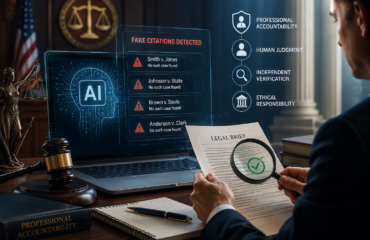


This article is part of the Hardwiring Justice series on Artificial Intelligence and the Justice System. This is Part 4 in the series examining how AI is shaping policing, prosecution, defense practice, and the courts.*
Applying the Standards to AI Evidence Categories
Artificial intelligence (AI) now generates evidence and outputs that directly influence judicial outcomes. Questions of AI evidence admissibility are therefore becoming central to modern litigation. Risk scores inform detention decisions. [1]Facial recognition matches appear in charging documents. [2] Automated transcripts stand in for recordings that juries never hear.[3] Algorithmic flags trigger supervision violations.[4]
These outputs do not escape evidentiary law because they carry a technology label. When an AI-generated result is used to prove a fact or influence an adjudication, it is evidence, and the standards governing its admissibility are not new. Frye,[5] Daubert,[6] Federal Rule of Evidence (FRE) 702[7], and their state analogs already apply. Understanding how those standards operate across the range of AI tools now embedded in the justice system is not optional for practitioners. It has become a baseline professional obligation.
Computer Vision and Facial Recognition
Computer vision tools analyze visual data to identify faces, read license plates, enhance video, or detect objects.[8] When a computer vision output is offered to connect a defendant to a location or act, it constitutes an assertion about identity that must satisfy evidentiary reliability standards.
Under Daubert/FRE 702 standard courts must evaluate the system’s testing protocols, known error rates, peer review history, and the standards controlling its operation.[9] Facial recognition systems generate probabilistic outputs with measurable false-positive rates that may vary across demographic groups.[10] Video enhancement systems may interpolate or reconstruct pixels in ways that alter perceived content.[11]
Despite widespread law enforcement use, no court has subjected facial recognition to a rigorous Daubert analysis and found it admissible as identification evidence, and law review scholarship directly confronting admissibility has generally concluded that the methodology lacks general acceptance within the relevant scientific community, casting serious doubt on whether facial recognition as actually deployed can satisfy Daubert’s testing and error rate requirements.[12]
Under Frye, the inquiry focuses on whether the specific methodology is generally accepted within the biometrics or computer vision research community.[13] This is a distinct question from whether the tool has been widely adopted by law enforcement agencies. In People v. Carrington,[14] a prosecution expert testified that facial recognition technology was “in its infancy” and that law enforcement did not use it as the sole basis to identify or eliminate a suspect , acknowledging that operational deployment had outpaced scientific validation.[15] That testimony, made in the context of a Kelly/Frye hearing, underscores that widespread law enforcement adoption of the technology but also suggests that it does not yet satisfy Frye’s general acceptance requirement.
Evidentiary Issue: A facial recognition output is a probabilistic assessment, not a definitive identification. Admissibility requires disclosure of the system’s error rate and the conditions under which the output was generated.
Automated Audio Transcription
Speech-to-text systems generate transcripts used in charging decisions, impeachment, and probation proceedings.[16]These systems infer words probabilistically from acoustic data and language models.[17]
If a transcript is introduced to establish what was said, reliability must be examined.[18] Courts should consider error rates under acoustic conditions comparable to the recording at issue, performance variation across accents and dialects, model versioning and updates since the time of the recording, and the availability of independent validation studies.[19]Automated transcription is not clerical work when it functions as evidence.[20] It is a technical methodology subject to Rule 702 and Daubert scrutiny.
Risk Assessment Instruments
Risk assessment tools generate predictive scores regarding future conduct.[21] When these scores are cited to justify detention or restrictive supervision, they operate as algorithmic assertions about future behavior.[22]
The result of these assessments must be understood as evidence subject to Frye or Daubert/FRE 702 scrutiny, requiring validation studies conducted on populations comparable to the defendant, disclosure of false positive and false negative rates, independent peer review of the methodology, and transparency sufficient for meaningful cross-examination. Proprietary models shielded from methodological scrutiny raise fundamental reliability concerns, because evidentiary law requires meaningful challenge, not merely the opportunity for it.[23]
That standard is difficult to satisfy when the methodology itself is inaccessible. Many AI systems operate as black boxes[24] with internal reasoning opaque even to their developers, raising a threshold question for any court: how can reliability be evaluated for a process that cannot be explained? In Wisconsin v. Loomis,[25] the court upheld the use of a proprietary risk assessment algorithm at sentencing despite the defendant’s inability to examine its methodology, reasoning it was merely one factor among many.[26] However, courts that admit AI-generated evidence without adequate scrutiny of the underlying methodology risk undermining both fairness and constitutional due process.
Validation Problem: Widespread judicial use does not establish scientific reliability. Many instruments in routine use have not been validated on the specific populations to which they are applied.

Machine-Learning Classification and Flagging Systems
Machine-learning systems flag anomalies such as behavioral patterns, digital communications, or geographic clusters for human review.[27] When cited to justify judicial findings, they function as classification evidence subject to reliability scrutiny.[28]
Courts should examine the composition of training data, bias mitigation efforts, false positive rates, and whether independent validation has occurred. The presence of a human reviewer does not eliminate the algorithm’s evidentiary role if the output materially shaped the factual record presented in the proceeding.
AI-Enhanced Evidence
AI-enhanced evidence presents distinct challenges when offered to a finder of fact like a jury. Unlike raw data or unaltered recordings, AI-enhanced outputs, whether clarified surveillance footage, noise-filtered audio, or reconstructed imagery, carry an implicit authority that jurors may struggle to evaluate critically. The concern is not merely accuracy but perception: jurors may tend to assign disproportionate weight to demonstrative evidence, a phenomenon courts have long recognized. Where the enhancement methodology has not been validated, peer reviewed, or tested for error rates, the risk is that the jury is not evaluating the underlying event but rather the algorithm’s interpretation of it.
Proposed Federal Rule of Evidence 707
The increasing complexity of layered algorithmic systems is precisely what has driven attention at the federal rule making level. A proposed Federal Rule of Evidence 707 would specifically address machine-generated outputs from forensic or algorithmic systems.[29] While still under consideration, the proposal reflects growing recognition that courts confront machine-derived results requiring structured reliability review.
The proposal tracks Rule 702: the proponent must establish that the system is reliable, that it was properly applied, and that the output is what it purports to be.[30] Whether adopted in its current form or modified, the proposal signals a clear direction. AI-generated outputs are evidentiary assertions subject to explicit judicial gatekeeping, and the standards governing that gatekeeping are becoming more detailed, not less.
Generative AI and Privilege
Although privilege doctrine differs from evidentiary reliability, it reflects the same underlying principle: existing legal standards govern AI tools without modification for novelty.
In United States v. Heppner,[31] the U.S. District Court for the Southern District of New York held that communications between a defendant and a publicly available generative AI system were not protected by attorney-client privilege or work-product doctrine.[32] The court reasoned that AI platforms are not lawyers, communications with them are not inherently confidential, and materials generated independently of counsel do not become privileged merely because they are later shared with an attorney.[33]
That holding returns the analysis to its foundation. Novelty does not create exemption from established doctrine, and the same evidentiary standards that have always governed technical proof in American courtrooms apply with equal force to algorithmic outputs today.
The Doctrinal Bottom Line: AI Evidence Admissibility
Artificial intelligence does not sit outside evidentiary law. Questions of AI evidence admissibility are governed by the same standards that apply to all technical proof. The governing standards, Frye, Daubert, Rule 702, and their state equivalents, already provide the analytical framework.
By the time AI outputs reach the courtroom, they may have already shaped charging decisions, investigative focus, or supervision conditions. That upstream influence makes downstream scrutiny more important, not less. Once introduced to justify liberty-affecting determinations, reliability standards must be applied with the same rigor courts bring to any other technical evidence. The evidentiary tools exist. The Judges and attorney’s obligation is to use them.
*This article was edited with the assistance of AI in the form of a large language model. It was used solely for grammar, editing, and footnote support. All substantive content and conclusions reflect human authorship.
[1] Bureau of Justice Assistance, What Is Risk Assessment, Public Safety Risk Assessment Claringhouse, (last visited Mar. 3, 2026).
[2] Clare Garvie, What Defense Counsel Should Know About Facial Recognition Technology, The Champion, May 2023, at 18.
[3] Nat’l Court Reporters Ass’n, Emerging Ethical and Legal Issues Related to the Use of Artificial Intelligence (AI), Automatic Speech Recognition (ASR), Voice Cloning, and Digital Audio Recording of Legal Proceedings (Nov. 2023).
[4] Anuar Assamidanov & Nicholas Powell, Striking a Balance: Human Discretion and Algorithmic Insights in Parole Supervision Decision-Making (Oct. 2023) (unpublished manuscript).
[5] Frye v. United States, 293 F. 1013 (D.C. Cir. 1923).
[6] Daubert v. Merrell Dow Pharmaceuticals, Inc., 509 U.S. 579 (1993).
[7] Federal Rule of Evidence 702: Fed. R. Evid. 702.
[8] Rina Diane Caballar & Cole Stryker, What Is Computer Vision?, IBM Think (last visited Mar. 3, 2026).
[9] Hon. Samuel A. Thumma, Science Bench Book for Judges § 7.2, at 221 (2d ed. 2020), https://justicespeakersinstitute.com/wp-content/uploads/2020/10/7-Trial.pdf.
[10] Patrick Grother, Mei Ngan & Kayee Hanaoka, Face Recognition Vendor Test Part 3: Demographic Effects, Nat’l Inst. of Standards & Tech. (Dec. 2019).
[11] Id.
[12] Paul W. Grimm, Maura R. Grossman & Gordon V. Cormack, Artificial Intelligence as Evidence, 19 Nw. J. Tech. & Intell. Prop. 9 (2021).
[13] Science Bench Book for Judges, supra note 9.
[14] People v. Carrington, No. B265888, 2018 WL 671903 (Cal. Ct. App. Feb. 2, 2018)
[15] Id.
[16] Antonino Ferraro, Antonio Galli, Valerio La Gatta & Marco Postiglione, Benchmarking Open Source and Paid Services for Speech to Text: An Analysis of Quality and Input Variety, 6 Frontiers in Big Data 1210559 (2023).
[17] Id.
[18] Emerging Ethical and Legal Issues, supra note 3.
[19] Ferraro et al., supra note 16.
[20] Emerging Ethical and Legal Issues, supra note 3.
[21] Evan M. Lowder, Carmen L. Diaz, Eric Grommon & Bradley R. Ray, Effects of Pretrial Risk Assessments on Release Decisions and Misconduct Outcomes Relative to Practice as Usual, 73 J. Crim. Just. 101754 (2021).
[22] Id.
[23] Andrea Nishi, Privatizing Sentencing, 119 Colum. L. Rev. 1671 (2019).
[24] A black box is a system, device, or process whose internal workings are hidden or unknown, but whose inputs and outputs can be observed and analyzed.
[25] Loomis v. Wisconsin, 881 N.W.2d 749 (Wis. 2016),
[26] Id.
[27] Purushottam Perapu, Anomaly Detection in User Behaviour Using Machine Learning for Cloud Platforms, 11 Int’l J. Sci. Rsch. Computer Sci. Engineering & Info. Tech. 805 (2025).
[28] Kashif Javed & Jianxin Li, Artificial Intelligence in Judicial Adjudication: Semantic Biasness Classification and Identification in Legal Judgement (SBCILJ), 10 Heliyon e30184 (2024).
[29] Proposed New FRE 707, UIC L. Libr. (June 10, 2025).
[30] Id.
[31] nited States v. Heppner, No. 25 Cr. 503 (JSR) (S.D.N.Y. Feb. 10, 2026) (oral ruling).
[32] Id.
[33] Id.
Get more articles like this
in your inbox
Subscribe to our mailing list and get the latest information and updates to your email inbox.
Thank you for subscribing.
Something went wrong.