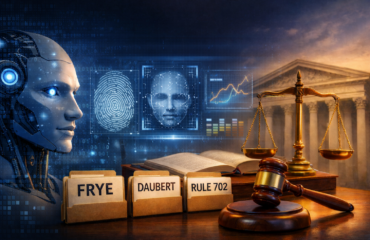


AI has crossed the threshold from innovation to application, compelling courts to balance technological advancement with the enduring principles of justice. From chatbots that guide self-represented litigants to advanced analytics that help courts manage crowded dockets, AI has arrived in the courtroom.[1] Yet as this technology’s reach expands, so too must justice professionals’ understanding of how to govern it. For courts, the question is no longer whether AI should be used, but how it can be employed with transparently and fairly while upholding the rule of law.
Two distinct frameworks, one a comprehensive report[2] and the other an online resource,[3] offer an initial roadmap that balances innovation with accountability and efficiency with respect for justice. Together, they affirm an emerging consensus that AI can advance justice, but only when rooted in law, guided by ethical judgment, and implemented with openness and accountability.
The Promise and Peril of AI in Justice
Courts are beginning to cautiously adopt artificial intelligence. This caution reflects not only a divide between those who see AI as a tool for greater efficiency and those who fear it may undermine fairness and impartiality, but also a broader uncertainty among justice system professionals about how the technology actually works.[4]
AI encompasses both predictive and generative systems.[5] Predictive AI analyzes data to identify patterns and forecast outcomes, while generative AI creates text, images, and even legal arguments.[6] Both raise profound questions: How can courts ensure transparency when algorithms are opaque? What happens when bias embedded in data becomes bias in decisions?
Experts offer a consistent warning: AI is a tool not an end itself.[7] It is valuable only when it demonstrably improves justice. Every implementation should begin with a simple question: What problem does this solve? Without that clarity, courts risk automating inefficiency or amplifying inequality.[8]

Justice and Fairness
Technology in the courtroom must comply with the same justice principles that have long defined the rule of law. Most importantly, judges must retain ultimate responsibility for decisions. AI may assist with research or data management, but it cannot replace judicial judgment without eroding public confidence in judicial independence.[9]
Increasing reliance on AI also raises new forms of imbalance and power. A handful of nations and corporations dominate AI development, shaping not only the tools but the very definitions of knowledge and truth. Such concentration risks entrenching inequality and undermining national sovereignty and justice processes.[10] Courts, therefore, must develop transparent procurement practices and local oversight mechanisms to ensure technology does not dictate the contours of justice itself.
Principles and Practices for Responsible Use of AI in the Courts
An emerging consensus supports an educated, incremental approach to AI adoption. Courts should begin with low-risk administrative applications—such as document summarization or docket management—before expanding to uses that directly affect litigants’ rights. Each implementation should serve a clearly defined purpose aligned with core judicial goals of efficiency, access to justice, and transparency.[11] In the evidentiary context, judges must also deepen their understanding of AI technologies to make informed and appropriate admissibility decisions.
Several key principles have emerged:
- Judicial oversight must always be preserved. AI may assist in drafting or analysis, but judges remain accountable for accuracy and fairness.[12]
- Written policies should govern use. Policies must define permissible applications, establish review procedures, and outline how misuse or error will be addressed.[13]
- Transparency and disclosure are essential. Litigants and the public should be informed when AI is used and for what purpose.[14]
- Risk classification should guide deployment. AI applications should be categorized as minimal, moderate, high, or unacceptable risk, based on their potential impact on legal rights. High-risk uses warrant heightened supervision or prohibition.[15]
These principles impose structure on what might otherwise become an unregulated legal landscape. They reflect the same balance of innovation and restraint that has long guided the evolution of judicial ethics.

Guardrails for the Judicial Future
AI should augment judicial judgement, not replace it. But responsible implementation requires clear guardrails, including:
- Ethical training for judges and staff to understand how AI works, its limitations, and how to detect bias or error.[16]
- Algorithmic transparency, ensuring courts can audit and explain the logic behind AI recommendations.[17]
- Public accountability, through published policies, community engagement, and oversight bodies that include technologists, ethicists, and judicial officers.[18]
- Impact assessments, including environmental and equity evaluations, to ensure that technology’s benefits do not come at the cost of fairness or sustainability.[19]
Judges must also remain vigilant about the appearance of fairness. If a decision relies on an AI system whose operation cannot be explained, public trust will inevitably erode, even if the outcome is legally correct. Procedural fairness, therefore, is not merely procedural; it is fundamental to judicial legitimacy.
AI in the Courts: The Path Forward
The use of AI in courts is inevitable. The question is whether its growth will strengthen justice or compromise it. The way ahead is to embed AI within the judiciary’s ethical framework, ensuring its use remains anchored in transparency and accountability.
Courts that adopt AI responsibly can become models for the broader public sector, demonstrating that innovation and integrity are not opposites but partners. Those that move too quickly, without guardrails, risk transforming the promise of AI into a new source of inequity.
AI is a valuable tool only when it demonstrably advances justice. Its role is to assist with efficiency and analysis, not to replace ethical or judicial judgment.
Other Articles in this Series
Introduction: Artificial Intelligence and the Courts: A Blog Series from Justice Speakers Institute
Part 1: AI in the Courtroom: Opportunities and Risks
Part 2: AI in the Courts: Ethical Challenges
Part 3: AI on Trial – Admissibility of AI-Generated Evidence
Part 4: Judicial Decision-Making: Transparency, Accountability, and the Judicial Role
Part 5: Courts of the Future-Innovation, Access, and Global Trends
Part 6: Judging the Machine-Lessons, Guardrails, and the Path Forward
[1] Nat’l Ctr. for State Cts., Chatbots and Virtual Assistants in Courts (2023), in Trends in State Courts 2023, at 10 (2023).
[2] Report of the Special Rapporteur on the Independence of Judges and Lawyers: Artificial Intelligence and the Courts, U.N. Doc. A/80/169, ¶ 1 (2025).
[3] Principles and Practices for AI Use in Courts, Nat’l Ctr. for State Cts. 3–5 (2024).
[4] Report on Artificial Intelligence and the Courts, supra note 2.
[5] Tim Mucci, Generative AI vs. Predictive AI: What’s the Difference?, IBM (Aug. 12, 2024).
[6] Id.
[7] J. Clement, As AI Spreads, Experts Predict the Best and Worst Changes in Digital Life by 2035, Pew Research Ctr. (June 21, 2023).
[8] Report on Artificial Intelligence and the Courts, supra note 2.
[9] Id.
[10] Id.
[11] Principles and Practices for AI Use in Courts, supra note 3
[12] Id.
[13] Id.
[14] Id.
[15] Id.
[16] Id.
[17] Id.
[18] Id.
[19] Id.
INTERESTED IN AI AND THE COURTS?
Artificial Intelligence is transforming justice. But it also raises complex questions of ethics, fairness and accountability. At the Justice Speakers Institute (JSI), we provide training, consulting, and expert presentations to help courts, policymakers, and legal professionals navigate these challenges responsibly.
Contact us today to learn how JSI can support your organization in understanding and implementing AI in the courts.
Get more articles like this
in your inbox
Subscribe to our mailing list and get the latest information and updates to your email inbox.
Thank you for subscribing.
Something went wrong.